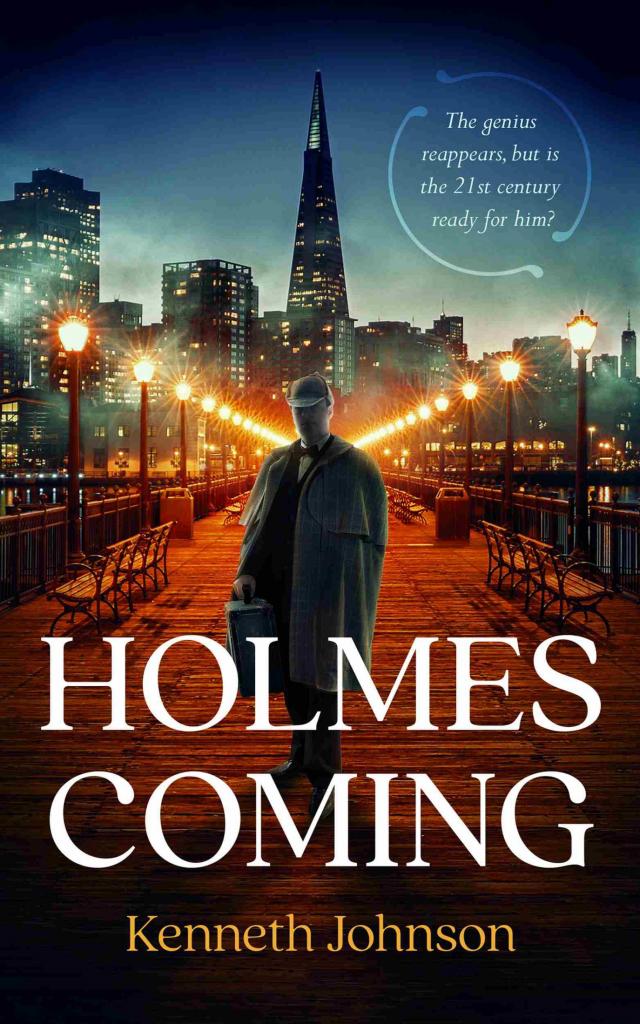
Holmes coming, p.1
Holmes Coming, page 1


Subscribe to our newsletter for title recommendations, giveaways and discounts reserved only for subscribers. Join here.
“Splashy Holmes redux executed with skill and style.”
—Kirkus Reviews
“Kenneth Johnson has written a novel that would make Conan Doyle proud. Clever, tight plots, fresh dialogue, and a take on Holmes that should not only be embraced by those delightful fans of Sherlock…but general readers who want a book that they won’t forget are guaranteed to become fans of the Great Detective.”
—Strand Magazine
“Having the actual character adapt to modern times is a fresh take on the detective. Johnson nails Holmes’s voice…his story is fun and engaging. Fans of the original adventures of Sherlock Holmes will enjoy.”
—Library Journal
“Johnson clearly knows and respects his source material…The game is definitely afoot…Splashy Holmes redux executed with skill and style.”
—Kirkus Reviews
“Readers are taken on a fantastic journey to discover the world’s favorite detective anew—a feat only Kenneth Johnson could possibly pull off. Highly recommended.”
—Gareth Worthington, PhD, Dragon Award–nominated author of It Takes Death to Reach a Star
“Johnson takes a big gamble by telling such a complex tale [in The Man of Legends] invoking every genre imaginable while juggling distinct and deep characterizations. The bet pays off, resulting in a story that will be popular with book clubs and fun to discuss.”
—Associated Press on The Man of Legends
“Kenneth Johnson…knows how to make magic.”
—Philadelphia Inquirer
“Johnson is especially effective…at introducing disparate, unrelated stories and slowly having them collide with one another throughout the course of the story.”
—Pittsburgh Post-Gazette on V
“With The Man of Legends Kenneth Johnson has once again created a timeless tale that offers up adventure, suspense, and romance all wrapped up tightly in a supernatural mystery.”
—Suspense Magazine on The Man of Legends
Copyright © 2021 Kenneth Johnson Productions, Inc.
E-book published in 2022 by Blackstone Publishing
Cover design by Alenka Vdovič Linaschke
All rights reserved. This book or any portion thereof may not be reproduced
or used in any manner whatsoever without the express written permission of the
publisher except for the use of brief quotations in a book review.
The characters and events in this book are fictitious.
Any similarity to real persons, living or dead, is coincidental
and not intended by the author.
Trade e-book ISBN 979-8-200-70686-0
Library e-book ISBN 979-8-200-70685-3
Fiction / Mystery & Detective / General
CIP data for this book is available from the Library of Congress
Blackstone Publishing
31 Mistletoe Rd.
Ashland, OR 97520
www.BlackstonePublishing.com
For David, Juliet, Michael, and Katie
with love . . .
Author’s Apology
You would likely think the story I’m about to tell is outrageously unbelievable—that is, if you hadn’t by now almost certainly seen mention of it in the media. Numerous outlets have carried reports regarding the apparent reemergence of an extraordinary individual.
It’s understandable that many accounts have not treated the matter seriously. Several sources openly satirized it with the cynicism typical of our overhyped, overspun social media age. And some, of course, have declared this remarkable occurrence to be an outright hoax.
It’s been suggested that to put the matter in proper perspective an eyewitness should come forward who could recount the entire adventure—a reputable eyewitness who was present from the beginning and also party to it throughout. Such a person should put forth, as concisely as possible, in clinical detail, the full story, complete with all its surprising twists and turns, as well as its intriguing mystery—and seeming magic.
Unfortunately, the person in the best position to accomplish that difficult task is me. So let me confess to you right here that my previous literary efforts have been confined to master’s theses and articles in obscure medical journals. What follows constitutes my first attempt as an actual author.
With that caveat, I hope you will enjoy—or at the very least, believe—the story I am about to tell. I expect you will be as astounded as I was while living through the six days and nights during which it took place.
Amy Elizabeth Winslow, MD
San Francisco, California
1
I am certain that when Donald Keating went out for his usual jog in the foggy San Francisco predawn darkness he had no idea what was lying in wait for him.
Keating was a healthy, athletic man of sixty-six, of Anglo heritage but proud that his great-grandmother had been a member of the Paiute Shoshone Nation. His favorite sweatshirt and pants were stenciled with the letters SFPD. He was five-foot-ten with gray hair well-trimmed and still in the tradition of regulation police cuts. It had become his accustomed hairstyle when he was a rookie beat cop some forty-five years earlier, and he still liked it. Sandy-brown highlights amid the gray hinted at the color it used to be. His carefully groomed mustache was thick. His brown eyes were clear and sharp.
For years he had taken the same jog at the same hour through the streets of his sleeping city. This early morning was particularly dark with dense fog, its dampening blanket contributing a serene quietness. Keating left from his apartment on Lombard, heading east through the lovely old North Beach section beneath Telegraph Hill. He turned south along Stockton, following his accustomed route. He saw the fog lights of an approaching squad car glowing through the thick mist. As the vehicle passed, he could just barely see inside the car the faces of Officers Craft and Viramontes, who smiled, nodding respectfully to him. He grinned back, recognizing them as his former students at the police academy.
Detective Keating had often told them and others how much he enjoyed being up and outside running in the darkness while most other citizens in his city were still in their last hours of sleep. It reminded him of his years as a beat cop, striving vigilantly to make the city a safer, more humane place. He had many decorations and honors to show for his years of service, but none gave him more pleasure than the feeling of the city’s people slumbering in safety just before dawn.
At the corner of Filbert, beefy, middle-aged Alfonso Nunez had opened his panel van and was dropping off the fresh bundles of the San Francisco Chronicle to a still-shuttered newsstand. He and Keating waved and smiled at each other as they always did on that same dark sidewalk. Both were punctual and consistent, and each enjoyed the comradeship of their greetings.
When Mr. Nunez later learned of the tragic horror that befell Detective Keating just minutes after their routine encounter, he was distressed and saddened. He contacted the police to report this earlier sighting and related how Keating had continued past him, running diagonally into shadowy Washington Square Park.
At 5:35 a.m., Keating reached the southwest corner of the park and crossed Union Street toward the new plaza mall recently built at Powell Street. It was a modernist building with a long set of wide steps ascending past a series of five terraces.
Detective Keating was in excellent physical condition. He prided himself on that. Even running up the long flights barely left him out of breath. But this time, as he reached the top of the steps at the fourth terrace, Keating slowed to a stop.
We know this because a stockbroker, Gabriel Farfan, working early, as always, at a building opposite on Powell, happened to glance out his nearby sixth-story window. Through drifting fog, Farfan spotted Keating below. He didn’t know Keating personally but recognized him from sightings as the man who often ran up those steps at that hour. Farfan later related to the police the disturbing details of what happened next.
Keating paused on the fourth terrace, which was about forty feet square. Its perimeter was planted with shrubbery about three feet tall, as well as flowers and a few small trees. That terrace, like the others below and above it, contained a shallow pool of water some thirty feet square.
The pool was unique in that it had a glass bottom, allowing daylight to filter pleasantly through it into a large marble atrium lobby built just beneath. It was essentially a skylight with water on top. But in the early-morning dark, the light from the lobby came the other way: up through the water. It cast quavering, unsettling shadows and reflections upon the angular marble walls of the terrace and its surrounding greenery.
Keating evidently sensed something was wrong—perhaps he even scented something. Younger officers were awed by the keen instincts Keating had honed to perfection during thousands of days and nights of policing. But he was about to face something he never would have imagined.
First came an unnerving sound. Two stories above the quiet plaza, Farfan heard it too and thought it was some kind of engine—a hefty motorcycle perhaps, low-pitched and rumbling. Maybe Keating thought that as well as he curiously glanced around. He zeroed in on the direction where the sound apparently came from: damp greenery on the opposite side of the low reflecting pool. Within those bushes, Keating might have seen a large shadow moving toward him.
When the ominous sound came again, Farfan re
It was a huge Bengal tiger.
Easily weighing four hundred pounds, the creature glided slowly out of the shadows. Its magnificent head was menacingly low, eyes laser-focused across the water on its prey.
Farfan saw Keating turn to run just as the tiger charged.
The massive animal leapt into the pool’s shallow water and galloped across it, the light streaming up from beneath the water adding a terrifying hellish aspect to the oncoming beast. Keating ran desperately across the plaza, his shouts for help echoing off the nearby buildings. But no help was to be had.
From his vantage point two stories above, Farfan was frantically dialing 911 while watching in horror as Keating fled back down the steps. But with its eight-foot strides, the tiger closed the distance between them in an instant. Keating looked back just as the giant beast leapt at him, smashing him down onto the concrete steps. He screamed in agony as the tiger’s claws clutched him, digging into his flesh as the beast’s fearsome mouth ferociously gaped open.
The tiger sunk its sharp teeth into the detective’s throat. Blood fountained out.
The arrival alarm sounded as duty nurse Lateesha James shouted, “Incoming!”
The ER doors from Saint Francis Memorial’s Pine Street ambulance entrance zipped open. A blood-spattered gurney bearing an unconscious Donald Keating sped in. He was on oxygen and had an IV in his right arm. One paramedic kept pressure on a blood-soaked neck-wound dressing while another pushed the gurney at full speed toward the waiting ER staff.
And me: Amy Winslow, MD.
I was in scrubs, pulling on my blue nitrile gloves but still shaking off sleep. Though I spent most of my time performing pediatric surgery, I worked extra shifts in the trauma center some nights to help out, particularly when there was a surge in patients.
“Take it into 4, Dr. Winslow,” Lateesha said as she started entering Keaton’s arrival information into our computer system.
In my time at Saint Fran, from a residency starting five years earlier, I’d seen all manner of injury, from gang violence to terrible car crashes to major industrial accidents. But I’d never seen anything like this.
Even Megan, a tall auburn-haired paramedic who was usually unflappable, looked grim as she delivered her rapid-fire brief while pushing the gurney: “Donald Keating. White, male, sixty-six. Attacked and mauled in midtown by a tiger—at least that’s what an eyewitness said.”
“A tiger?” I was stunned. “In the middle of the city?”
“Multiple lacerations, near amputation of right arm,” Megan continued. “Both carotids punctured.”
When a fellow human being is as ravaged as Donald Keating was, I can’t always remain as coolly professional as I’d like. I strive to remember my training, to hold back feeling too much empathy, which might cloud my professional usefulness, but I confess that I’m not always successful.
Nonetheless, I took charge as I walked beside the rapidly moving gurney, surveying the awful damage. Keating’s clothes had been shredded; large flaps of skin had been clawed open and folded back. I lifted the dressing from his face and could see his teeth, white gums, and jawbone through a three-inch hole in his left cheek.
I spread his left eyelids, shining my Maglite into his eye, calling out, “Patient unresponsive, ready an OR, notify neurosurgeon.”
A nurse peeled away to carry out my directions as we headed into unit 4, stopping the gurney beside the bed, under the white glare of an operating light. Everyone knew their positions on either side of the gurney and bed as I called, “Transfer on my count: one, two—three.”
Together as one, we shifted Keating’s limp body onto the bed.
“Get him intubated, Ysie,” I directed, “Seven-point-five tube.”
Ysabel, the respiratory therapist, went to work. Ysie was barely five feet tall and sturdy. We’d had many smiles together when she shared stories about her quirky family in Peru. But that night she was all business, working like lightning above Keating’s head to get a tube down his throat, then calling it: “I’m in.”
Megan caught my eye as she glided the gurney out and away. She didn’t look hopeful but offered, “Good luck, Doctor.”
My team bustled around the bleeding victim. A new nurse I didn’t know with frizzy blue hair had uncovered his chest and was attaching cardio sensor patches. I saw how several sets of four parallel lacerations had been clawed deep into Keating’s flesh, exposing the ribs and sternum beneath. I called out to the resuscitation nurse: “What’s hanging, Curt?”
“Large bore in right and left antecubital,” he answered. “Lactated ringers up. IV one has four hundred cc count. Two has six hundred.”
The blue-haired nurse, checking the monitor screens, chimed in, “Blood pressure ninety over sixty-four. Falling fast. Pulse one thirty-two.”
“I’m ventilating patient,” Ysabel said, “One hundred percent O₂.”
“Type and cross for six units of RBCs,” I said urgently to the nurse who’d just returned from making the neurosurgeon call. “Curt, keep the pressure on that carotid.”
A tall thirtyish Latino man in jeans and a leather windbreaker rushed up just outside the unit, breathing hard. After flashing his SFPD badge at Lateesha, he hovered near the unit’s door, his face etched with concern.
A steady tone began, and the blue-haired nurse called out, “He’s coding.”
I waved everybody back as I said, “Paddles.”
Curt handed me the cream-colored defibrillation paddles with the stainless-steel bottoms. I grabbed them and rubbed them together to spread out the contact gel.
Curt checked the console and nodded to me. “Charged.”
I placed them atop Keating’s bloody chest at the apex and sternum, then shouted, “Clear!” The team stepped back. I pressed the button.
Ka-thunk! Two hundred joules of electricity coursed through Keating. His dying body briefly arched up off the table before slumping back down.
The flatline tone continued.
Ysie pressed a stethoscope to his bloody chest and shook her head. “Nothing, Doctor.” Nonetheless, I tried again.
“Give me three hundred, Curt. Clear!” Another jolt. Another convulsion of his body. But nothing else. I shouted to the patient, “Come on, Mr. Keating! Clear!” Another jolt.
No response. And it was apparent to all that there wouldn’t be. I paused a long moment. Finally, I glanced at the clock, breathed a regretful sigh, and said quietly, “6:13 a.m.”
It was always so hard to call it.
Donald Keating was only the third trauma patient who had died under my direct care since I had begun practicing. I heaved a long sigh and told the nurse to determine whether Mr. Keating was a registered donor and contact his next of kin. Then I looked over at the plainclothes officer in the doorway and saw tears welling in his brown eyes as he stared at the deceased man I’d been unable to save. I was upset, disappointed with myself, but he looked much worse: completely bereaved. He slowly turned away.
A short time later, after I’d cleaned up and collected myself, I went out into the ER corridor, rubbing my eyes. I felt drained. The ER had quieted by then. I spotted the officer sitting nearby, still visibly overcome with emotion.
Lateesha had told me his name was Luis Ortega. In his early thirties, his face—indeed, his whole persona—seemed to emanate an earnest dignity. He had thick black hair above a high forehead and dark brown eyes, which were downcast with grief. He wore a simple gold wedding ring. He’d been joined by another detective wearing a tan, cord carcoat: Lieutenant Bernie Civita, thinning dark hair, olive skin, a guy who liked his pasta a tad too much. He was completely empathetic and clearly there to lend moral support to his comrade.
I stopped beside them. “Lieutenant Ortega? I’m so sorry.” He glanced up briefly, then nodded. I sat on the edge of a chair next to him. “Detective Keating was a close friend?”