

Indigo road, p.1
Indigo Road, page 1


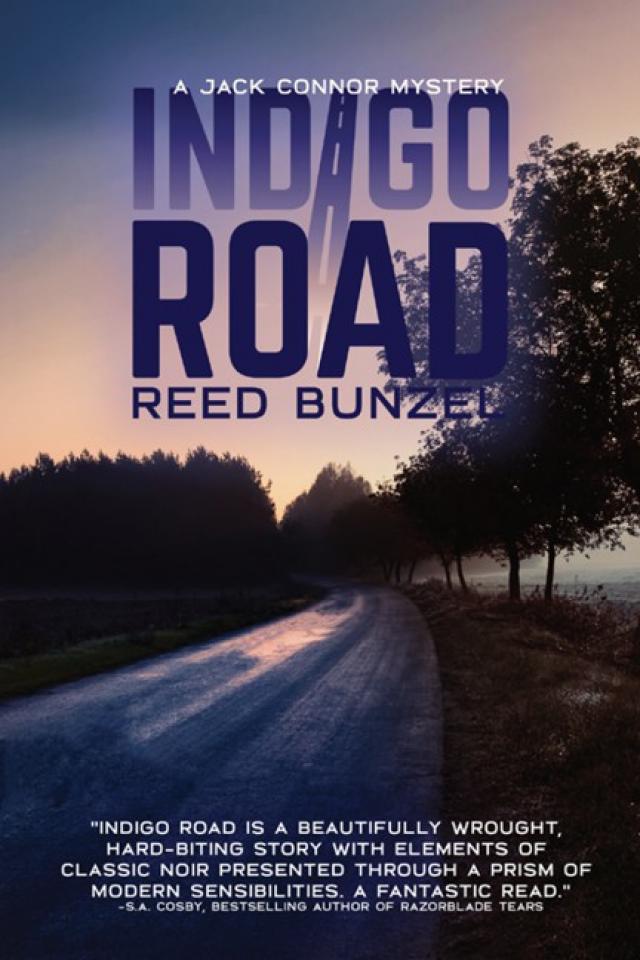
Indigo Road
Reed Bunzel
Kenmore, WA
A Coffee Town Press book published by Epicenter Press
Epicenter Press
6524 NE 181st St.
Suite 2
Kenmore, WA 98028
For more information go to:
www.Camelpress.com
www.Coffeetownpress.com
www.Epicenterpress.com
Author’s website: www.reedbunzel.com
All rights reserved. No part of this book may be reproduced or transmitted in any form or by any means, electronic or mechanical, including photocopying, recording, or any information storage and retrieval system, without permission in writing from the publisher.
This is a work of fiction. Names, characters, places, brands, media, and incidents are the product of the author’s imagination or are used fictitiously.
Indigo Road
2023 © Reed Bunzel
ISBN: 9781684922048 (trade paper)
ISBN: 9781684922055 (ebook)
LOC: 2022946248
Printed in the United States of America
For Jennifer – Love you three.
Chapter 1
Lengthening shadows of slash pines and swamp chestnuts reached across the blacktop, as if grasping at the last filaments of daylight Willis Ronson would see before returning to his cell at the county jail.
There would be no bond this time. No leniency from the judge who first time around had set bail at twenty grand and then released him into the custody of his fuming wife. No more oyster roasts or shrimp boils, no whisky and billiards at the corner tavern. No slap-and-tickle with said wife on Sunday mornings before she headed off to church, or on Tuesday afternoons if her boss gave her a few hours off from her job adjusting the hems of other women’s dresses.
The sinking knowledge of this fast-approaching deprivation was etched deep in his face as he stared at the sunbaked road stretching out before him. Sitting upright in the back seat, one hand cuffed to the steel support of the head rest in front of him. Not saying a damned word, at the advice of his court-appointed public defender, who had insisted on coming along for the ride and was positioned directly in front of him. Not something she did for all her bond-skippers, but she didn’t trust Ronson to keep his mouth shut.
Nor Jack Connor’s pledge not to try to get him talking on the ride home.
“It’s going to be a good, long time before you get to see any of this again,” was how Connor put it, talking over his shoulder to his prisoner. Or, in the eyes of the state of South Carolina, his apprehended ward. “You have anything to say for yourself before we get you checked into Leeds?”
Leeds being the colloquial term for the Sheriff Al Cannon Detention Center, located on Leeds Avenue in North Charleston.
“Don’t listen to him,” the lawyer warned Ronson, not for the first time. Her name was Cherine Dupree, no more than three years out of law school. Black skin that spoke to her coastal Gullah heritage, wire-rim glasses and double gold posts in the lobe of each ear. An angel’s face, fresh and naïve and searching for the good in everybody, no matter what he or she had done.
Allegedly.
“I’m just keepin’ to myself and enjoyin’ the peace and quiet of nature,” Willis Ronson lied. No expression on his pale white face, barely blinking his red eyes that were puffy from a long liaison with a bottle the night before, even though he’d insisted it was just a bout of the flu that was causing him to spit up bile. “Soaking in all the green and blue out there.”
“Cuz you know what it’s like in there,” Connor reminded him.
He knew Ronson had done two stretches before, and now here he was again, looking at five to ten for attempted theft of copper wire from a power company transformer station. Came this close to getting the life shocked out of him, after taking a massive set of bolt cutters to cables that could have been carrying thousands of live volts. Typical Carolina redneck whose brain stem got separated from common sense at an early age, and who had rapidly descended into high crimes and misdemeanors from that moment onward.
“Why do you think I done what I done, and split?
Ronson’s attorney glanced at her client over her shoulder, said, “Willis, please…I told you not to—”
She never got to finish her words. At that moment a bullet tore through the rear window of the Jeep Cherokee, shattering it in a cascade of diamonds before it bit into the windshield just below the rear-view mirror. A web of cracks spread instantly across the glass, leaving a hole the size of a wolf spider in the center.
Half a second later bullet number two entered the vehicle through the opening created by the first. It struck Ronson in the back of the neck, taking out his cerebellum and altering the trajectory of the slug just enough for it to become embedded in the side support pillar between the front and rear door. If that shot hadn’t killed him, the next surely did, as it penetrated his skull and rattled around the cranium a short while before exiting through his left eye and coming to stop in the head rest in front of him. Death had been instantaneous and his body had been blown forward and down, so rounds four and five missed him completely.
Instead, Cherine Dupree screamed as the first of those next two rounds plunged directly into her shoulder. The next one slammed through her seat back, its path diverted only slightly by a metallic lumbar support that redirected it into her lower torso. The bullet came to rest precariously close to her L5 vertebrae, which later would cause her team of surgeons considerable worry and grief.
The average human reaction time from the moment of stimulus to the transmission of a signal through the spinal cord to the muscles—resulting in spontaneous nerve contraction—is less than a quarter of a second. Connor’s was a bit faster than average, but not quick enough to cause him to do anything but spin the wheel reflexively to the right just after the windshield was cratered. He’d barely seen the vehicle racing up behind him, only a blur of motion in his side-view mirror a fraction of a second before the shooting erupted and his sensory system kicked in.
This action came far too late to save the life of Willis Ronson, whose range of motion was limited by the high-tensile steel chain of the handcuffs. By the time the fifth bullet had penetrated Cherine’s back, Connor had wrenched the wheel back again to the left. Too fast and too far, because at that point the Cherokee was riding on two tires, and a moment later it was rolling side-over-side into a deep run-off ditch that paralleled the narrow county road. Each fragmented second that came next seemed to be marked by more gunshots, although no one but the man holding the weapon in the pick-up twenty yards back was keeping count.
One of those subsequent rounds struck Ronson a third time, a wasted chunk of lead since he was already bleeding out. The final shot managed to graze the back of Connor’s right hand, carving a furrow in the compass rose that had been tattooed there a few years back. The impact caused him to release his grip on the wheel, and a moment later his arms and legs were flailing around inside the vehicle like the limbs of an untethered crash test dummy.
At some point every airbag in the vehicle deployed. At least half of the fourteen bones in Cherine Dupree’s face were fractured by the sudden blast, while Connor endured a similar assault to his mandible and maxilla, as well as a roundhouse punch to his left ear. Because Willis Ronson was riding in the backseat, he was spared any such injuries which, because he was already deceased, would have been postmortem and therefore inconsequential.
The SUV continued in a forward, yawing motion for a few more seconds before it came to rest upside down in a trickle of brackish water left over from a flash thunderstorm the evening before. The trunk of a blackjack oak absorbed most of the impact, the force of which drove the six-cylinder engine rearward through the firewall and into young attorney’s legs, snapping them like saplings. Her injuries, combined with the blood loss from her gunshot wounds, caused her to slip into hypovolemic shock and black out.
So did Connor, momentarily, until he blinked his eyes open and tried to regain his bearings. First thing he realized was he was hanging from his three-point seatbelt which, along with the water trickling through the shattered side window across the ripped headliner, told him the car was upside down. His head throbbed from what sure as hell felt like a skull fracture of great magnitude, probably a concussion. His jaw and nose seemed as if they’d just gone ten rounds in the ring, his ribcage punched as if he’d been gored by a bull running through the streets of Pamplona. His hand stung like a sonofabitch where the bullet had slashed his skin, and his ankle screamed from momentarily being twisted backwards.
His mind reflexively jumped back to the desert outside Kirkuk, that blistering day when a burning sun was hanging in a dusty sky as white as linen, sand biting at his parched lips like mites. He was at the wheel of a Humvee, bouncing over crumbled bricks and stone in a blown-out neighborhood northwest of the city, when a suicidal zealot cuffed to the wheel of a van packed with explosives came racing out from behind a mound of rubble that at one time had been a market. The blast had blown Connor up and outward, causing him to cartwheel through the air before he came to rest in a field of rocks, wondering if he was dead or still in the living hell known as war.
He’d lost a good friend that day, a young Texas all-state quarterback named Danny Benson who had been riding shotgun in the passenger seat next to him when the bomb detonated. Poor kid never had a chance. Several others had lost toes
Eddie James, who had drawn gunner duty, was blown into the air, his arm severed at the elbow by the force of the initial blast. He came to rest on what was left of the front passenger door that had done nothing to protect Private Benson, and opened a bloody fissure in the side of his head. It was a miracle he was alive.
All this swept through Connor’s brain in a microsecond, caused him to glance over at Cherine Dupree, who also was hanging upside down. Either dead or unconscious, he couldn’t be sure. Blood was everywhere, no way to know if it belonged to him, or her, or Willis Ronson in the backseat. Who likewise was hanging from his three-point restraint and the handcuffs, although he most definitely was no longer among the living.
A faint moan bubbled from Cherine’s lips, indicating that she was breathing—but for how long? There was nothing Connor could do to help her unless he freed himself from his own safety belt, so he wriggled his feet around until he was able to brace them against the steering wheel. He then used his good hand to probe for the latch between his seat and the center console. He pressed the button and immediately dropped to the mangled ceiling, which was sticky with blood and covered with fragments of tempered glass. His ribs cursed with pain—although nothing like that day in Kirkuk—but he knew Cherine Dupree was in far worse condition.
He managed to position himself partly beneath her, pushing up on the shoulder that wasn’t bleeding to give her just enough slack so he could click her belt latch. When he did, she tumbled down on top of him, momentarily pinning him against the roof. He felt, rather than heard, a low gasp seep from her lungs and, for a second, he wondered if it might have been her last. He felt her wrist for a pulse, found something that seemed no more than a quiver.
Alive, but losing a lot of blood.
It was then that he heard a voice. Or was it his own mind starting to grow numb, a deceased relative calling to him from across the great divide? No, that would hardly be possible, since most of his known family was a full time zone away, and none of them—not even the dead—wanted anything to do with him. Plus, he was quite sure he was only bleeding from superficial wounds and, at least in his mind, he hadn’t really been shot.
A second later Connor heard the voice again. Muffled and tentative, and a little guttural. It also meant there had to be at least two voices, because human conversation generally required more than one person. Logic that was spot on, because he then heard a response that was a bit louder, more decisive. In charge.
“Hold your fire.”
It sure didn’t sound like some good Samaritan who had witnessed the crash and pulled to the side of the road to check for casualties and assist the injured.
Hold your fire. Which meant guns, and fingers on triggers.
All of which Connor took to mean these were the same bastards who had raced up behind them and laid siege on his Jeep, killed Willis Ronson, and critically wounded Cherine Dupree. And in the process had run them all off the road.
Now it seemed they were moving through the brackish run-off ditch, coming to finish them off.
Chapter 2
As a state-licensed bond-runner, Connor had considerable latitude when tracking down bail skips. One perk of his job was the pistol he kept in his glove compartment, which he’d made sure was loaded before setting out in pursuit of Willis Ronson. While he didn’t care much for guns, they’d been a fact of life and death from the moment he’d hit boot camp, and had saved his life on more than one occasion. Even so, following his discharge from the army, he’d done his best to distance himself from them as best he could. Too many of his brothers in arms had turned their weapons against their wives or girlfriends, or themselves. The seduction of the trigger was incredibly strong, and the result so incredibly permanent.
As someone once said, the problem with temptation is that you may not get another chance.
Today, however, he needed the SIG Sauer P365 he’d picked up several months ago at Pawn-O-Rama in North Charleston. Problem was, the entire dashboard on the passenger side had been driven inward from the impact with the tree, coming dangerously close to crushing Cherine Dupree’s chest. Connor knew the glove box was there, somewhere, tangled in the deflated airbag, and after a few desperate seconds his probing fingers eventually managed to pry it loose. All while the voices outside the car inched closer and closer.
The micro-compact 9mm pistol dropped to the ceiling and Connor grabbed it, the quick motion sending a spear of pain through the bones of his right hand. He winced, then twisted his body back to where he could get a good look—and a clean shot—at whoever was approaching.
“You think that’s him, hanging there?” the first voice asked. Tentative and anxious, close enough to see inside the vehicle. Just a few yards away now, on Connor’s side of the Jeep.
“Looks like,” the leader replied. “Take it slow and easy.”
“What about the others?”
“Can’t see ‘em.”
“I know I had to’ve hit ‘em—”
“I said, hold your fire.”
Just then another voice called out, this one louder but at a much greater distance. Most likely up on the shoulder of the road. “Everyone all right down there?”
“Fuck,” the leader cursed. Hushed and pissed at the same time, close enough for Connor to hear the phlegm in his lungs. Then he ordered, “Stand down.”
“But—”
“Be cool. No shooting.”
Connor heard a grunt of discontent; then the leader called out, “Looks real bad. Can you call nine-one-one?”
“Ten-four,” the guy up at the road responded.
There was a short silence, no more than a few seconds. Then the closer, more tentative voice whispered, “What now?”
“Now we get the fuck out of here.”
“But—”
“Move out. Back to the truck. And hide the fucking gun.”
“But the others…they may be alive—”
“We’ll deal with them later,” the leader said. “Let’s go.”
The two men then seemed to move back toward the road, their retreating voices replaced by the steady rhythm of blood pulsing through Connor’s brain.
Connor refused medical help. Despite the pounding in his skull and the stabbing pain in his joints and chest, he insisted he was fine.
The cops and EMTs on the scene overruled him. Possible concussion and broken ribs, bruises and contusions just about everywhere. Signs of mental confusion and disorientation. Forty minutes later the ER doctor at the hospital in Kingstree concurred, and ordered him to spend the night for observation. More than a simple precaution, considering the magnitude of the accident and the condition of the other two passengers in the vehicle. One dead, one critical.
Connor argued that he felt better than fine, and Clooney—his chocolate lab rescue who right now was patiently waiting for him in his corner of the bar—needed to be fed and walked. Not necessarily in that order.
“Call someone,” the humorless doctor said, handing him a phone.
His skull felt as if it had been used as a soccer ball and his memory was cloudy. Without access to his digitized contacts, it took him a few minutes to remember the number for Julie, his ace bartender who had agreed to single-handedly navigate the Sunday crowd at the bar. She gave him a load of shit for not showing up on time, until Connor explained that he was in the hospital out in the middle of bum-fuck nowhere.
“What the hell happened—?”
“Accident,” he explained, not wanting to get into it. “I’ll fill you in whenever they let me out of here.”
“You sure do know how to step in shit, Jack,” she said. “You want me to keep Clooney for the night?”
“If you could, I’d owe you big time,” he replied.
“Don’t make promises you can’t keep,” Julie told him.
Connor handed the phone back, and the doctor and attending nurse left him alone in the ER examining room. His thoughts bounced around, from Iraq to the shoot-out to his weeks in rehab, then back to Iraq. Eventually his mind drifted to The Sandbar down in Folly, just a few steps from the beach at The Edge of America, as the locals called it. His home now for almost two years, slinging drinks never being something he’d pictured himself doing and now couldn’t see himself doing anything else but. The bounty hunting thing was just a side hack he did a couple days a month, to shake things up a bit and because he was good at it. Right now, he couldn’t think of anywhere he’d rather be than behind the counter, mixing a gin and tonic or showing off the stupid magic tricks he’d learned at the VA rehab joint in Georgia.









